Interest Subsidy for Solar Plant in Gujarat: Complete Guide for MSMEs, Industries & Renewable Energy Investors
Installing a solar power plant can significantly reduce electricity costs, but the initial investment often becomes a barrier for businesses. To accelerate renewable energy adoption, the Government of Gujarat offers interest subsidy benefits for eligible MSMEs investing in solar and renewable power plants for captive consumption.
If you are planning a rooftop solar project, ground-mounted solar plant, or renewable energy system in Gujarat, understanding the available interest subsidy can help lower your financing costs and improve project returns.
Quick Answer
Interest subsidy on solar projects in Gujarat ranges from 5% to 7% depending on the Taluka category of the manufacturing unit. Eligible MSMEs may receive an additional 1% subsidy if they qualify as women entrepreneurs, startups, differently abled entrepreneurs, or young entrepreneurs.
The maximum annual subsidy ranges from ₹25 lakh to ₹35 lakh and can be availed for up to 7 years, subject to applicable government guidelines.
In addition to interest subsidy, businesses may also benefit from capital subsidies, accelerated depreciation, net metering benefits, and various renewable energy incentives offered by central and state governments.
What is Interest Subsidy for Solar Plants?
Interest subsidy is a financial incentive provided by the government to reduce the interest cost on loans taken for setting up solar or renewable energy projects.
Instead of providing the entire project cost as a grant, the government reimburses a portion of the interest paid on eligible project loans.
This helps businesses:
- Reduce financing costs
- Improve project cash flow
- Achieve faster payback periods
- Increase Internal Rate of Return (IRR)
- Make renewable energy investments more affordable
For MSMEs, this can substantially improve the economics of captive solar power generation.
Why Gujarat Encourages Solar and Renewable Energy Investments
Gujarat is one of India's leading renewable energy states.
The state has:
- High solar irradiation levels
- Strong industrial infrastructure
- Favorable solar policies
- Growing demand for clean energy
- Large manufacturing and MSME ecosystem
The government aims to reduce dependence on conventional energy while helping industries lower electricity expenses and improve sustainability.
As a result, several incentives are available for solar and renewable energy projects.
Interest Subsidy for Solar Plant in Gujarat
Under various MSME and industrial promotion initiatives, eligible enterprises investing in captive-use renewable energy systems may receive interest subsidy benefits on project loans.

The objective is to encourage:
- Rooftop solar plants
- Ground-mounted solar projects
- Hybrid renewable energy systems
- Wind-solar hybrid installations
- Renewable captive power generation
Interest subsidy generally applies to the term loan component used for project implementation.
Key Benefits
| Benefit | Impact |
| Reduced Interest Burden | Lower financing cost |
| Faster Payback | Improved project economics |
| Better Cash Flow | Reduced EMI pressure |
| Higher ROI | Better investment returns |
| Increased Adoption | Encourages clean energy investment |
Interest Subsidy Rates Based on Taluka Category
One of the most important aspects of Gujarat's interest subsidy framework is that the subsidy is linked to the location of the manufacturing unit, not necessarily the location where the solar or renewable energy plant is installed.
The Government of Gujarat classifies Talukas into different categories under its Industrial Policy to promote balanced industrial development.
Interest Subsidy Rates by Taluka Category
| Taluka Category | Interest Subsidy | Maximum Subsidy Per Year | Duration |
| Category 1 Taluka | 7% | ₹35 Lakhs | 7 Years |
| Category 2 Taluka | 6% | ₹30 Lakhs | 6 Years |
| Category 3 Taluka & Municipal Areas | 5% | ₹25 Lakhs | 5 Years |
Key Takeaway
A manufacturing unit located in a Category 1 Taluka receives the highest interest subsidy support, making solar and renewable energy projects significantly more attractive from a financing perspective.
Final classification of Talukas is determined by the Government of Gujarat under the prevailing Industrial Policy.
Additional 1% Interest Subsidy (If You Qualify)
An additional 1% interest subsidy may be available for special categories of entrepreneurs.
| Category | Conditions |
| Women Entrepreneur | 100% ownership by women |
| Differently Abled Entrepreneur | 100% ownership by differently abled entrepreneurs |
| Registered Startup | Recognized by DPIIT (GoI) or Government of Gujarat |
| Young Entrepreneur | Age below 35 years at the time of loan sanction with 100% ownership |
Example
Suppose a woman entrepreneur owns a manufacturing MSME located in a Category 1 Taluka.
- Base Interest Subsidy = 7%
- Additional Benefit = 1%
Total Eligible Subsidy = 8%
This can significantly reduce financing costs and improve solar project economics.
Meaning of Category 1, Category 2 and Category 3 Talukas
Many investors and MSMEs are confused about Taluka categories.
Under Gujarat Industrial Policy, Talukas are classified based on industrial development levels.
Category 1 Talukas
These are relatively less industrialized regions.
The Government provides the highest level of incentives to attract investment into these areas.
Benefits include:
- Highest interest subsidy
- Longest subsidy duration
- Higher annual subsidy cap
- Additional industrial incentives
Category 2 Talukas
Moderately developed areas receiving substantial support for manufacturing growth and employment generation.
Category 3 Talukas and Municipal Areas
Industrialized regions that continue to receive incentives, though at comparatively lower rates.
Businesses planning solar investments should check the latest Government classification before project execution.
Important Conditions MSMEs Must Know
Before applying for interest subsidy on solar projects, enterprises should understand the following conditions:
Minimum Interest Payable
A minimum effective interest rate of 2% must always be borne by the MSME, even after accounting for all central and state subsidies.
Combined Subsidy Restrictions
If interest subsidy is also received from the Government of India, the Gujarat Government subsidy may be adjusted to ensure the enterprise still pays at least 2% net interest.
Loan Default Impact
If the enterprise defaults and the account becomes overdue by more than 90 days as per RBI norms, the default period may be excluded from subsidy eligibility.
Loan Takeovers
Where loans are transferred between banks, subsidy calculations are generally based on the lower of:
- Outstanding principal amount, or
- Newly sanctioned term loan amount
Eligible Renewable Energy Projects
Interest subsidy may be available for:
Solar Rooftop Projects
Suitable for:
- Factories
- Warehouses
- Commercial buildings
- Educational institutions
- Hospitals
Ground-Mounted Solar Plants
Suitable for:
- Industrial campuses
- Manufacturing facilities
- Agro-processing units
Solar-Wind Hybrid Systems
Projects combining multiple renewable energy sources.
Captive Renewable Power Plants
Projects developed primarily for self-consumption rather than power sale.
Who Can Apply?
The exact eligibility depends on prevailing government schemes and policy notifications.
Generally, beneficiaries may include:
MSMEs
- Micro Enterprises
- Small Enterprises
- Medium Enterprises
Manufacturing Units
Industries with significant electricity consumption often gain the maximum benefit.
Commercial Establishments
Subject to applicable scheme guidelines.
Industrial Parks and Clusters
Shared renewable energy infrastructure may also qualify under specific programs.
How Interest Subsidy Improves Solar Project ROI
Many businesses focus only on solar panel costs and electricity savings.
However, financing cost significantly impacts project profitability.
Example
Assume:
- Solar Plant Cost = ₹50 lakh
- Loan Amount = ₹40 lakh
- Interest Rate = 10%
- Loan Tenure = 7 years
Without subsidy:
- Interest burden remains high.
With subsidy:
- Effective borrowing cost decreases.
- Annual savings increase.
- Payback period reduces.
- Project IRR improves.
For large industrial installations, this can translate into substantial savings over the project lifecycle.
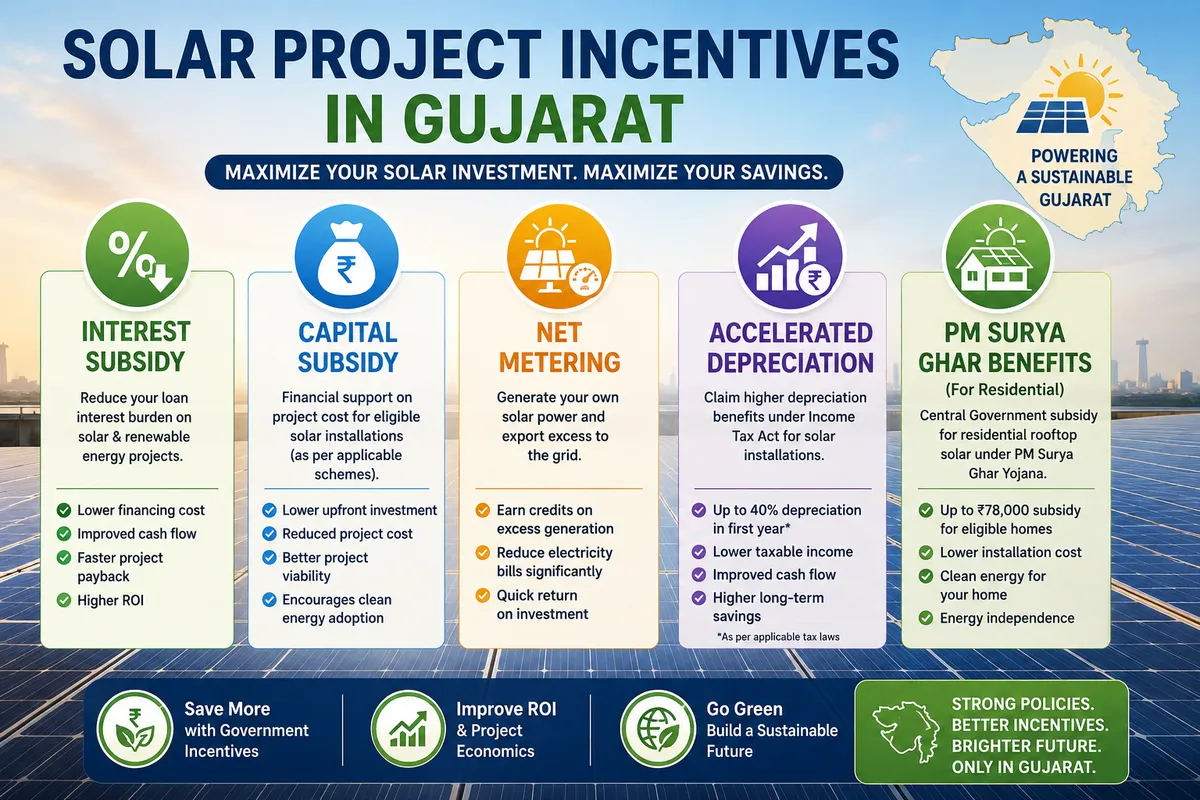
Other Solar Subsidies Available in Gujarat
Apart from interest subsidy, businesses should evaluate additional incentives.
Capital Subsidy
Certain schemes provide direct financial assistance toward project costs.
PM Surya Ghar Yojana
Primarily for residential consumers installing rooftop solar systems.
Net Metering Benefits
Allows consumers to export excess solar electricity to the grid.
Accelerated Depreciation
Businesses can claim depreciation benefits under applicable tax provisions.
Renewable Energy Incentives
Special incentives may be available under state-specific industrial and renewable energy policies.
Combining multiple incentives can significantly improve project viability.
Solar Subsidy Gujarat: Residential vs Commercial
| Parameter | Residential | Commercial | Industrial |
| PM Surya Ghar Subsidy | Yes | No | No |
| Net Metering | Yes | Yes | Yes |
| Interest Subsidy | Limited | Scheme-Based | MSME Focused |
| Accelerated Depreciation | No | Yes | Yes |
| Captive Solar Benefits | Limited | Yes | Yes |
How to Apply for Interest Subsidy on Solar Projects
Step 1: Project Planning
Determine:
- Plant size
- Technology
- Expected generation
- Financing requirement
Step 2: Loan Sanction
Obtain financing from:
- Public sector banks
- Private banks
- NBFCs
- Renewable energy financing institutions
Step 3: Project Installation
Install through an experienced solar EPC contractor.
Step 4: Documentation Submission
Submit all required subsidy documentation.
Step 5: Verification
Authorities review project and financing records.
Step 6: Subsidy Approval
Approved applicants receive subsidy benefits according to scheme provisions.
Documents Typically Required
- MSME Registration Certificate
- Company PAN
- GST Registration
- Loan Sanction Letter
- Bank Statements
- Solar Project Invoice
- EPC Agreement
- Plant Commissioning Certificate
- Electricity Connection Documents
- Detailed Project Report (DPR)
Why Industries in Ahmedabad are Investing in Solar
Ahmedabad has emerged as one of Gujarat's strongest industrial and commercial hubs.
Major reasons include:
- Rising electricity tariffs
- Attractive subsidy structure
- Better project economics
- ESG compliance requirements
- Long-term energy security
Industrial facilities with high daytime electricity consumption can often achieve substantial savings through captive solar generation.
Expert Insight
The biggest mistake many businesses make is evaluating solar projects purely on installation cost.
A better approach is to calculate:
- Total financing cost
- Available subsidies
- Taluka category benefits
- Additional entrepreneur incentives
- Tax benefits
- Net metering savings
- Long-term electricity inflation
When interest subsidy is combined with solar energy savings, project economics become substantially stronger.
Conclusion
Interest subsidy for solar plants in Gujarat is one of the most valuable financial incentives available to MSMEs and industrial consumers investing in renewable energy.
Depending on the Taluka category, eligible enterprises can receive between 5% and 7% interest subsidy, with an additional 1% available for qualifying entrepreneurs such as women-owned businesses, startups, differently abled entrepreneurs, and young entrepreneurs.
By reducing loan servicing costs, interest subsidy improves cash flow, shortens payback periods, and increases overall project returns.
Businesses planning a solar project should evaluate all available incentives—including interest subsidy, capital subsidy, net metering benefits, and tax advantages—to maximize financial returns.
With Gujarat continuing to lead India's renewable energy transition, there has never been a better time to invest in solar power.
Frequently Asked Questions (FAQs)
What is interest subsidy for solar plants?
Interest subsidy is a government incentive that reduces the interest burden on loans taken for eligible solar and renewable energy projects. Instead of directly funding the project cost, the government reimburses a portion of the interest paid on the term loan.
Who can avail interest subsidy on solar projects in Gujarat?
Eligible beneficiaries generally include:
- Micro Enterprises
- Small Enterprises
- Medium Enterprises (MSMEs)
- Manufacturing Units
- Captive Renewable Energy Users
- Eligible Commercial Establishments
Applicants must satisfy the conditions specified under the applicable Government of Gujarat scheme.
What is the interest subsidy available for solar projects in Gujarat?
The subsidy depends on the category of the Taluka where the manufacturing unit is located:
| Taluka Category | Interest Subsidy |
| Category 1 Taluka | 7% |
| Category 2 Taluka | 6% |
| Category 3 Taluka & Municipal Areas | 5% |
What is the maximum interest subsidy available in Gujarat?
Eligible enterprises may receive:
| Taluka Category | Maximum Annual Subsidy |
| Category 1 | ₹35 Lakhs |
| Category 2 | ₹30 Lakhs |
| Category 3 | ₹25 Lakhs |
Additional benefits may be available for eligible entrepreneurs.
How long can an MSME receive interest subsidy?
The duration depends on the Taluka category:
| Taluka Category | Duration |
| Category 1 | 7 Years |
| Category 2 | 6 Years |
| Category 3 | 5 Years |
Is the subsidy based on the location of the solar plant?
No.
The interest subsidy is generally linked to the location category of the manufacturing unit rather than the location where the renewable energy plant is installed.
This is one of the most important conditions many businesses overlook.
What are Category 1 Talukas in Gujarat?
Category 1 Talukas are relatively less industrialized regions identified by the Government of Gujarat for accelerated industrial development.
These areas receive:
- Highest interest subsidy
- Longest subsidy duration
- Highest annual subsidy cap
- Additional industrial incentives
What are Category 2 Talukas in Gujarat?
Category 2 Talukas are moderately developed industrial regions that receive substantial government support to attract new investments and employment generation.
What are Category 3 Talukas in Gujarat?
Category 3 Talukas and municipal areas are relatively developed industrial regions where incentives continue to be available, though at comparatively lower rates.
Can women entrepreneurs receive additional interest subsidy?
Yes.
A woman entrepreneur with 100% ownership of the enterprise may be eligible for an additional 1% interest subsidy over and above the normal subsidy entitlement.
Can startups get extra subsidy on solar projects?
Yes.
DPIIT-recognized startups or startups recognized by the Government of Gujarat may qualify for an additional 1% interest subsidy.
Is there any subsidy for young entrepreneurs?
Yes.
Entrepreneurs below 35 years of age at the time of term loan sanction may qualify for an additional 1% subsidy, provided they have 100% ownership of the enterprise.
Can differently abled entrepreneurs get additional benefits?
Yes.
Enterprises that are 100% owned by differently abled entrepreneurs may qualify for an additional 1% interest subsidy.
What is the maximum subsidy a woman entrepreneur can receive?
For example:
- Base Subsidy in Category 1 Taluka = 7%
- Additional Women Entrepreneur Benefit = 1%
Total Eligible Interest Subsidy = 8% Subject to applicable scheme conditions and annual subsidy caps.
Is interest subsidy available for rooftop solar projects?
Yes.
Eligible rooftop solar projects installed for captive consumption may qualify under applicable government schemes.
Is interest subsidy available for ground-mounted solar plants?
Yes.
Ground-mounted captive solar projects developed by eligible MSMEs may qualify for interest subsidy benefits.
Is interest subsidy available for renewable power plants other than solar?
Yes.
Certain renewable energy projects such as:
- Solar-Wind Hybrid Systems
- Captive Renewable Energy Plants
- Other eligible renewable power generation systems
may qualify under applicable government policies.
What is the difference between capital subsidy and interest subsidy?
Capital Subsidy
Reduces the project cost directly.
Interest Subsidy
Reduces the interest payable on the loan used to finance the project.
Both incentives improve project economics but work differently.
Can capital subsidy and interest subsidy be claimed together?
In many cases, multiple incentives may be available simultaneously.
However, applicants should verify current government guidelines before planning their project financing structure.
What is the minimum interest rate that an MSME must pay?
Even after receiving Central and State Government subsidies, the MSME must bear a minimum effective interest cost of 2%.
What happens if I receive subsidy from the Government of India?
If interest subsidy is also received from a Central Government scheme, the Gujarat Government subsidy may be adjusted to ensure that the enterprise still pays at least 2% effective interest.
What happens if the loan account becomes overdue?
If the loan account remains overdue for more than 90 days as per RBI norms, the default period may be excluded from the subsidy eligibility period.
What happens if I transfer my loan to another bank?
In case of loan takeover or refinancing, subsidy calculations are generally based on:
- Actual principal outstanding, or
- Newly sanctioned loan amount
whichever is lower.
How does interest subsidy improve solar project ROI?
Interest subsidy:
- Reduces financing cost
- Improves cash flow
- Increases annual savings
- Improves project IRR
- Shortens payback period
This makes solar investments significantly more attractive for MSMEs and industries.
What documents are required for interest subsidy applications?
Typically required documents include:
- MSME Registration Certificate
- GST Registration
- PAN Card
- Loan Sanction Letter
- Bank Statements
- Solar Project Invoices
- EPC Agreement
- Commissioning Certificate
- Electricity Connection Documents
- Detailed Project Report (DPR)
Which industries benefit the most from solar interest subsidy?
Industries with high daytime electricity consumption generally receive the greatest benefits, including:
- Textile Manufacturing
- Engineering Units
- Pharmaceuticals
- Food Processing
- Chemical Industries
- Packaging Units
- Warehousing Facilities
Which cities in Gujarat are adopting solar energy rapidly?
Leading solar adoption markets include:
- Ahmedabad
- Surat
- Rajkot
- Vadodara
- Gandhinagar
- Bharuch
- Jamnagar
- Bhavnagar
Is solar investment still profitable after subsidy?
Yes.
When combined with:
- Interest Subsidy
- Net Metering
- Accelerated Depreciation
- Reduced Electricity Bills
solar projects often deliver attractive long-term returns and significant energy cost savings.
Should MSMEs invest in solar power in Gujarat?
For most electricity-intensive businesses, solar power combined with available government incentives can significantly reduce operating costs and improve long-term competitiveness.
The actual financial benefit depends on:
- Plant size
- Electricity consumption
- Financing structure
- Taluka category
- Available subsidies
- Applicable tax benefits