One-Stop Decision Enginefor Solar & EV
Switch to Solar & EV with confidence. Compare options, calculate savings, and get the best installation quotes across India.
SimplifyingSolar&EVDecisionsforEveryone
SOLEV helps individuals, businesses, and investors make smarter energy choices by providing expert consulting and cutting-edge tools for Solar and EV adoption.
Learn More
0+
Solar Installation 2025

0+
Happy Clients
PoweringYourFuture
Everything you need to make a smart, confident switch to solar and EV all in one place.
Calculate Solar Savings
Find out exactly how much money you'll save on your electricity bills every month.
Check Government Subsidy
See the latest govt. discounts you can get and how to apply for them easily.
Find EV Charging Stations
Never run out of charge. Find the nearest charging points around you in seconds.
Compare EV Vehicles
Confused which car to buy? Compare range, price, and features side-by-side.
Calculate Charging Cost
See how much you save per kilometer by switching from petrol to electric.
Explore Solar for Home & Business
From small homes to big factories, find the perfect solar setup for your space.
OurSolutions
Solar Solutions
End-to-end solar solutions for homes, businesses, and industries with complete support from consultation to installation.
EV Infrastructure
Discover EV charging stations, understand charging costs, and plan your trips without range anxiety.
Energy Calculators
Calculate savings, compare EV vs petrol costs, estimate payback periods, and make informed decisions.
Consulting & Support
Get expert guidance for solar installation, EV adoption, and business opportunities in clean energy.
WhatMakesUsDifferent
We combine expertise, innovation, and sustainability to deliver solar solutions you can rely on.
Affordable & Cost-Saving
Save up to 40% on electricity bills with smart solar solutions.
Eco-Friendly Solutions
Reduce carbon footprint and protect the environment.
24/7 Customer Support
Always here when you need us, day or night.

CleanEnergyMadeSimple
A smooth step-by-step process to help you discover, compare, and adopt sustainable energy solutions.
Explore
Discover solar solutions, EV options, and energy tools.
Calculate
Estimate savings, ROI, and charging costs instantly.
Connect
Find trusted vendors and nearby charging stations.
Take Action
Start your clean energy journey with confidence.
BuildYourFutureInCleanEnergy
Discover growing opportunities in solar and EV industries. From investments to infrastructure, SOLEV helps you explore the next generation of sustainable businesses.
Start a Solar Business
Set up EV Charging Stations
Explore Franchise Opportunities
Understand ROI & Investment

NumbersThatReflectRealProgress
Helping people and businesses adopt cleaner, smarter, and more sustainable energy solutions across the country.
0+
Installations
Solar projects completed
0+
Cities Covered
Across India covered
0+
Partners
Trusted network
0+
Happy Customers
Satisfied clients
WhatOurClientsSay
“SOLEV made understanding solar savings effortless. My bill dropped by 74% in just 6 months — couldn't be happier!”
Rajesh Patel
Happy Homeowner, Ahmedabad
Insights&UpdatesFromtheWorldofSolar
Explore practical guides, industry trends, and clean-energy insights designed to help you stay informed.
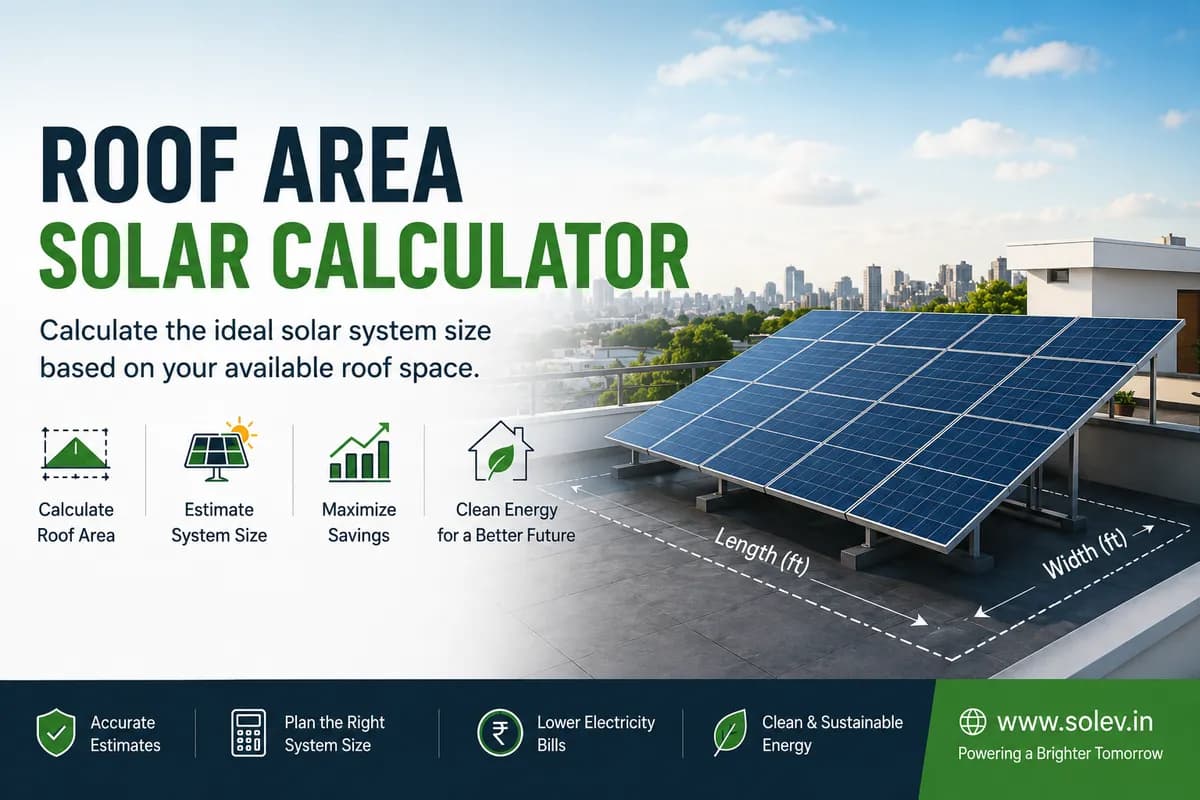
Roof Area Solar Calculator – Calculate Required Roof Space for Solar Panels (India)
Roof Area Solar Calculator Planning to install a rooftop solar system? One of the first questions homeowners and businesses ask is: "How much roof area is required for solar panels?" Our Roof Area Solar Calculator helps you estimate the ideal solar system size based on your available rooftop space. Whether you're planning a 3kW, 4kW, 5kW, 6kW, 10kW, or larger solar system , this calculator provides an accurate estimate of the solar capacity that can be installed on your roof. The calculation is based on standard high-efficiency solar panels commonly used in India and includes sufficient spacing for installation and maintenance. Why Roof Area Matters for Solar Installation The amount of electricity your solar system can generate depends largely on the number of solar panels installed. Since every panel occupies physical space, your available rooftop area determines the maximum system size you can install. Factors affecting roof area requirements include: Solar panel efficiency Panel dimensions Roof shape Tilt angle Maintenance walkway Shadow-free area Roof obstacles such as water tanks and vents A professional site survey will provide the most accurate capacity estimate . Standard Roof Area Required for Solar Systems in India The table below provides approximate roof space requirements for commonly installed residential solar systems. Solar System Size Approximate Roof Area Required Number of Panels (Approx.) 1 kW 60 sq. ft. 2 Panels 2 kW 120 sq. ft. 4 Panels 3 kW 180 sq. ft. 6 Panels 4 kW 240 sq. ft. 8 Panels 5 kW 300 sq. ft. 10 Panels 6 kW 360 sq. ft. 12 Panels 8 kW 480 sq. ft. 16 Panels 10 kW 600 sq. ft. 20 Panels Note: Actual requirements may vary depending on the panel wattage and installation layout. [CALCULATOR] Roof Area Required for 3kW Solar System A 3kW solar system typically requires approximately 180 square feet of shadow-free roof space. This system generally consists of 6 high-efficiency solar panels and is suitable for homes consuming around 300–400 units of electricity per month . Roof Area Required for 4kW Solar System A 4kW rooftop solar system requires around 240 square feet of usable roof area. It usually includes 8 solar panels and is ideal for medium-sized households with monthly electricity consumption between 450 and 600 units . Roof Area Required for 5kW Solar System A 5kW solar system requires approximately 300 square feet of shadow-free roof space. This is one of the most popular residential system sizes in India and generally consists of 10 high-efficiency solar panels . It is suitable for homes consuming 600–750 electricity units per month . Roof Area Required for 6kW Solar System A 6kW rooftop solar system requires around 360 square feet of usable rooftop area. The system generally uses 12 high-efficiency solar panels and is recommended for larger homes with electricity consumption between 750 and 900 units per month . How to Calculate Roof Area for Solar Panels Calculating your roof area is simple. Formula: Roof Area = Roof Length × Roof Width For example: Roof Length = 30 feet Roof Width = 20 feet Roof Area = 600 sq. ft. Using this roof area, you can generally install a 10kW solar system , depending on roof conditions. Factors That Affect Solar Panel Roof Space Several factors influence the actual roof area required . Solar Panel Efficiency Higher-efficiency solar panels generate more electricity using less space. Roof Orientation South-facing roofs generally provide the highest energy generation in India. Tilt Angle Panels installed at an optimal tilt require slightly more spacing than flush-mounted panels. Shadow-Free Area Trees, nearby buildings, chimneys, water tanks, and parapet walls can reduce the usable installation area. Walkway Requirements Maintenance access should always be considered while designing the panel layout. Which Solar Panel Requires Less Roof Area? Modern TOPCon solar panels produce more power from the same area compared to older polycrystalline panels. Using high-efficiency panels can reduce the overall roof area required while increasing electricity generation. Can Solar Panels Be Installed on Small Roofs? Yes. Even if your roof has limited space, high-efficiency solar panels can help maximize power generation. Professional designers can optimize panel placement around obstacles and maximize rooftop utilization. Benefits of Using a Roof Area Solar Calculator Estimate maximum solar capacity Plan rooftop utilization Compare different system sizes Understand installation feasibility Prepare for site surveys Estimate future electricity savings Frequently Asked Questions (FAQs) How much roof area is required for a 3kW solar system? A 3kW solar system typically requires around 180 square feet of shadow-free rooftop area. How much roof area is required for a 4kW solar system? A 4kW rooftop solar system generally requires approximately 240 square feet of usable roof space. How much roof area is required for a 5kW solar system? A 5kW solar system typically requires around 300 square feet of shadow-free rooftop space. How much roof area is required for a 6kW solar system? A 6kW solar system generally requires approximately 360square feet of usable roof area. How many solar panels are required for a 3kW solar system? A 3kW system usually requires 6 high-efficiency solar panels of approximately 540–550W each. How many solar panels are required for a 5kW solar system? A 5kW solar system generally requires 10 solar panels depending on the panel wattage. Can I install solar panels on a 500 sq. ft. roof? Yes. A 500 sq. ft. roof can generally accommodate a 8kW rooftop solar system , subject to shadow-free conditions and roof layout. How do I calculate roof area for solar panels? Multiply the roof length by the roof width to determine the available roof area. How much electricity does a 5kW solar system generate? A 5kW solar system in India typically generates 550–700 units of electricity per month , depending on location, weather, and system performance. Which roof is best for solar panels? South-facing roofs with minimal shading and adequate structural strength are generally considered ideal for rooftop solar installations in India. Can solar panels be installed on RCC roofs? Yes. RCC (Reinforced Cement Concrete) roofs are among the most common and suitable roof types for rooftop solar installations. Can I install solar panels if my roof has water tanks? Yes. Solar panels can often be designed around water tanks and other rooftop structures, provided sufficient shadow-free space is available. Do solar panels require maintenance space? Yes. A small maintenance walkway is generally recommended to allow safe access for cleaning and servicing. Does panel efficiency affect roof space? Yes. Higher-efficiency solar panels generate more electricity using less roof area, allowing a larger system to fit on the same rooftop. How accurate is a roof area solar calculator? A roof area calculator provides an estimate based on standard installation assumptions. Final system sizing should always be confirmed through a professional site survey.
ARUN GUPTA
July 29, 2026
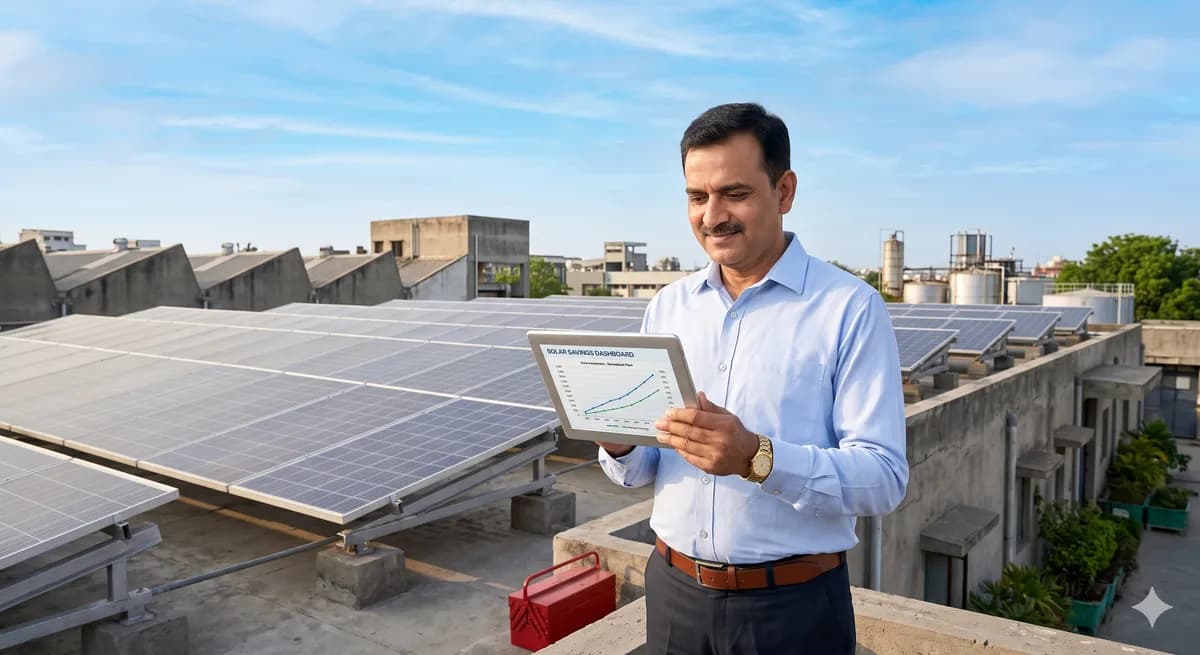
The Real ROI of Industrial Solar in India: Payback Periods, Depreciation, and the Math Vendors Don't Show You
Every solar vendor pitching your factory will tell you the same thing: "3 to 5 year payback." It's become such a standard line that it's stopped meaning anything. The real question isn't whether that range is possible — it's whether it applies to your facility, under your tariff, with your financing structure. Without seeing the underlying math, "3 to 5 years" is just a sales line, not a financial commitment. This article walks through the actual industrial solar ROI math: what drives payback period, what tax benefits actually apply to commercial buyers (and which ones don't), and how to decide between owning your system outright versus a zero-upfront-cost alternative. The Subsidy Myth: What Commercial and Industrial Solar Buyers Actually Get Let's clear up the most common misunderstanding first, because it derails a lot of industrial solar ROI conversations before they even start. PM Surya Ghar Muft Bijli Yojana — India's flagship solar subsidy scheme — is a residential program. It does not apply to private commercial or industrial solar buyers. If a vendor implies you'll receive a central capital subsidy similar to what homeowners get, that's not accurate for your situation. There's also no broad central capital subsidy for private commercial and industrial (C&I) solar projects more generally in 2026. Government-backed schemes like the CPSU Scheme Phase II exist, but they're built for public sector undertakings and government entities — not private factories. So where does the financial case for industrial solar ROI actually come from? Two places: Lower electricity costs. Solar-generated electricity for commercial and industrial users now costs roughly ₹3.0–3.5 per kWh (levelized cost of electricity, or LCOE) — a sharp drop from ₹4.5–5.0 per kWh just a few years ago. For most C&I consumers, that's meaningfully below grid tariffs. Accelerated depreciation. As a business asset, your solar installation qualifies for depreciation benefits under Indian tax provisions, which materially improves the after-tax economics. (We're intentionally not quoting a specific depreciation rate here — tax provisions can change, and you should confirm the current applicable rate with your CA before building it into your model.) Worked Example: Industrial Solar ROI for a 1 MW Captive Plant Numbers make this concrete. Here's an illustrative — not promotional — walkthrough of how industrial solar ROI is typically modeled for a 1 MW captive rooftop or ground-mounted plant. Annual generation: A 1 MW plant operating at a realistic capacity utilization factor (CUF) of around 19% generates approximately 16–17 lakh units (kWh) per year. Energy value created: If that generation offsets grid power at a representative industrial tariff of around ₹7/kWh, the gross energy value is approximately ₹1.1–1.2 crore per year. Net operating benefit: After accounting for operations and maintenance (O&M) costs, the net annual benefit typically lands around ₹1.0–1.1 crore. Payback window: Against a total installed cost of roughly ₹3.5–4.5 crore for a 1 MW system, this generally produces a payback period in the range of 3 to 4 years — consistent with industry benchmarks, but only once you've seen exactly how that number was derived. This is illustrative math, not a guarantee — your actual industrial solar ROI will depend on your specific tariff, your state's net metering or open access rules, your roof or land configuration, and your financing structure. But this is the kind of calculation your vendor should be willing to walk through with you, line by line, rather than just stating a headline payback figure. CAPEX vs. RESCO/PPA: Which Funding Model Actually Fits Your Business There isn't just one way to finance a commercial solar project, and the model you choose changes your industrial solar ROI picture significantly. CAPEX Model (You Own the Asset) You pay the full installed cost upfront (or via a loan) You own the system and the electricity it generates You're eligible for the full accelerated depreciation tax benefit Higher upfront cash requirement, but the strongest long-term financial upside RESCO / PPA Model (Zero Upfront Cost) A third-party developer installs and owns the system on your roof or land You pay a discounted, pre-agreed rate per unit of electricity consumed — typically lower than your grid tariff No upfront capital outlay, no depreciation benefit (since you don't own the asset) Lower risk, lower complexity, but a smaller share of the long-term financial benefit stays with you A simple way to decide: if your business has available capital and meaningful tax appetite, CAPEX generally delivers stronger long-term industrial solar ROI . If you'd rather avoid tying up capital or taking on asset ownership risk, RESCO/PPA gets you immediate savings with zero upfront investment — a reasonable trade-off for many growing businesses. What Vendor ROI Pitches Usually Leave Out A polished sales pitch and an honest industrial solar ROI model often look very different. Here's what tends to get glossed over: Module degradation over time. Solar panels lose a small percentage of output capacity every year over their 25-year lifespan. A model that assumes flat generation for 25 years is overstating your long-term returns. Realistic O&M costs. Skipping or underbudgeting maintenance can mean losing 10–20% of generation to soiling and component wear within just a few years — directly eating into the savings your payback calculation assumes. Tariff escalation assumptions. Most vendor pitches calculate savings using today's electricity tariff. If your state's grid tariffs rise over the next several years (historically a near-certainty), your real savings — and real industrial solar ROI — could be even better than the original pitch suggested. But if a vendor's model doesn't disclose its tariff assumption at all, you can't tell whether you're looking at a conservative number or an inflated one. Build Your Own Number — Don't Borrow Theirs The honest version of industrial solar ROI isn't a single sales-deck number — it's a model built around your actual tariff, your actual roof or land, your actual financing preference, and a realistic maintenance plan. Any vendor unwilling to walk you through that full model, line by line, is asking you to take their payback claim on faith. SOLEV builds a customized ROI model for every facility we work with — not a generic payback range, but your actual numbers. Request a customized ROI model for your facility from SOLEV → Frequently Asked Questions 1. What is a typical industrial solar ROI payback period in India? Most commercial and industrial solar systems in India achieve payback within 3 to 5 years, depending on system size, your local electricity tariff, financing model, and maintenance plan. The exact figure should come from a model built around your specific facility, not a generic industry range. 2. Do commercial and industrial solar buyers get a government subsidy in India? No. PM Surya Ghar Muft Bijli Yojana, India's main solar subsidy scheme, applies only to residential consumers. Private commercial and industrial buyers don't receive a comparable central capital subsidy, though they can access accelerated depreciation benefits and, in some states, additional incentives. 3. What's the difference between CAPEX and RESCO models for industrial solar ROI? Under CAPEX, you pay the full cost upfront, own the system, and capture the full depreciation tax benefit along with the strongest long-term ROI. Under RESCO/PPA, a third party owns and operates the system on your premises, you pay a discounted per-unit rate with zero upfront cost, but you don't receive ownership benefits like depreciation. 4. How does accelerated depreciation affect industrial solar ROI? As a business asset, a solar installation qualifies for depreciation benefits under Indian tax provisions, which improves after-tax returns for buyers using the CAPEX ownership model. The exact applicable rate can change, so it's worth confirming the current provision with your tax advisor before finalizing your financial model. 5. What do solar vendors typically leave out of their ROI pitches? Common omissions include long-term panel degradation, realistic ongoing O&M/maintenance costs, and the electricity tariff escalation assumption used in their payback calculation. Ask your vendor to disclose all three explicitly before relying on their payback number. 6. Is industrial solar ROI different for a 100 kW system versus a 1 MW system? Yes. Larger systems generally benefit from better per-watt installation costs and stronger economies of scale, which can improve payback timelines. However, site-specific factors like roof condition, shading, and local tariff structure also significantly affect the final ROI for any given system size.
ARUN GUPTA
June 26, 2026
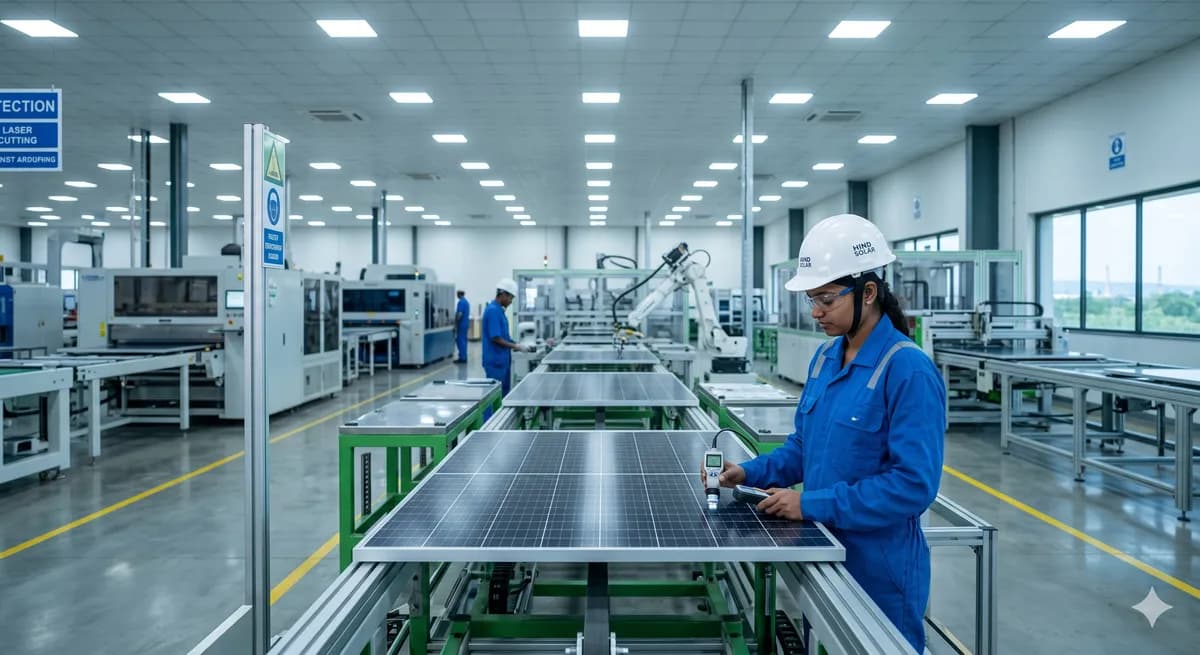
ALMM 2026: What India's New Solar Module Rules Mean for Your Factory's Project (And Why Timing Matters Now)
If you're mid-planning a commercial or industrial solar project right now, there's a regulatory deadline you need to understand clearly — not from a WhatsApp forward, but from the actual notification. From June 1, 2026 , India's ALMM 2026 rules require that solar projects using net metering or open access be built with modules and cells from the government's approved manufacturer lists. This isn't a future possibility. It's already in force. This article explains exactly what ALMM 2026 covers, who it actually affects, and what to check before you sign anything for your factory's solar project. What ALMM Actually Is, in Plain Language ALMM stands for Approved List of Models and Manufacturers — a framework maintained by India's Ministry of New and Renewable Energy (MNRE). It exists in two parts: ALMM List-I covers approved solar module manufacturers — essentially, which finished panel brands and models are certified for use. ALMM List-II covers approved domestic solar cell manufacturers — this is the newer, more demanding layer, because it governs what's actually inside the panel, not just who assembled it. The distinction matters: a panel can be assembled in an Indian factory under an Indian brand name and still fail List-II compliance if the solar cells inside it were imported, often from China. Under ALMM 2026 rules, both layers matter for certain project types. What Changed Under ALMM 2026, and When The Ministry of New and Renewable Energy confirmed in a notification dated May 25, 2026 that there would be no blanket extension of the ALMM List-II deadline beyond June 1, 2026. Here's what that means in practice: From June 1, 2026 , net-metering and open access solar projects must use modules from ALMM List-I built with solar cells from ALMM List-II. Projects commissioned before June 1, 2026 are exempt from the List-II cell requirement — they're effectively grandfathered in under the previous rules. Limited case-by-case relief is available for projects that have already made significant progress — for example, where modules have been installed but commissioning is pending, or where land acquisition, financial closure, or connectivity arrangements are already underway. Developers seeking this relief must file documented claims through a dedicated portal, with submissions accepted only through June 30, 2026. This is a meaningfully different situation from a blanket "non-DCR panels are banned" headline you may have seen — the rule is specific, dated, and has defined exemption pathways, which is exactly why it pays to understand the details rather than react to the panic version. Who ALMM 2026 Actually Affects This is the part most factory owners get wrong, so it's worth being precise. ALMM 2026 List-II requirements apply if your project involves: Net metering (where you export surplus solar power to the grid and draw back from it) Open access (where you procure renewable power through grid-connected open access arrangements) Government-backed schemes, government projects, or projects under government programs ALMM 2026 List-II requirements currently do not apply to: Purely captive, behind-the-meter systems used entirely for self-consumption with no grid export In other words, if your factory's planned solar system involves net metering or open access — which is true for most commercial and industrial installations that interact with the grid in either direction — ALMM 2026 applies to you. If you're planning a fully isolated, off-grid captive system with zero grid interaction, the List-II cell requirement currently doesn't apply, though ALMM List-I module certification considerations may still be relevant depending on your scheme. The Compounding Cost Effect: ALMM 2026 and Rising Solar Prices Here's why ALMM 2026 matters financially, not just procedurally. India's domestic solar cell manufacturing capacity sits at roughly 27–31 GW, while domestic module assembly capacity is significantly higher — creating a real supply gap for cell-compliant components, particularly in high-efficiency technologies like TOPCon. This supply-demand mismatch is a meaningful contributor to the broader commercial and industrial solar cost increase of roughly 25% year-over-year that buyers are seeing in 2026 (covered in detail in our cost breakdown article). If you received a solar quote before this year, or even early in 2026, it likely doesn't reflect current ALMM-compliant component pricing — which means the number you've been planning your budget around may already be out of date. What to Check Before Signing Any Solar Contract Right Now Given the ALMM 2026 mandate, here's a short, practical checklist before you commit to any vendor for a net-metered or open access commercial solar project: Confirm the specific panel model is on the current ALMM List-I — not just that the manufacturer's brand appears somewhere on the list in general. Confirm the cells inside that module are sourced from an ALMM List-II approved domestic supplier , if your project involves net metering or open access. Ask explicitly whether your vendor's stock is pre- or post-mandate — some vendors may still be working through inventory procured before the cell requirement took effect, which could affect both pricing and your project's compliance status. Confirm BIS certification independent of ALMM listing — these are related but distinct quality checks. If your project has already started (land secured, modules delivered, or commissioning pending), ask your EPC partner whether you may qualify for case-by-case relief, and what documentation that requires. Why Timing Your Decision Matters More Than Ever ALMM 2026 isn't just a compliance checkbox — it's actively reshaping component availability and pricing across the industry in real time. Acting on outdated information, whether that's an old quote or a vague understanding of what's actually banned versus what isn't, puts your project timeline and your budget at risk. SOLEV's projects are built around current ALMM-compliant sourcing, so you're not exposed to compliance risk or last-minute pricing surprises partway through your project. Talk to SOLEV about an ALMM-compliant solar project for your facility → This article reflects MNRE notifications as of June 2026. ALMM provisions and exemption details can be updated by the Ministry, so confirm current requirements with your EPC partner or directly via MNRE's official notices before finalizing any contract. Frequently Asked Questions 1. What is ALMM 2026 and when does it take effect? ALMM 2026 refers to the enforcement of ALMM List-II requirements for solar PV cells, effective June 1, 2026. It requires that net-metering and open access solar projects commissioned on or after this date use solar modules built with domestically manufactured, approved solar cells. 2. Does ALMM 2026 apply to my factory's solar project? It applies if your project involves net metering or open access — which covers most grid-connected commercial and industrial solar systems. Purely captive, behind-the-meter systems with no grid export are currently exempt from the List-II cell requirement. 3. Is there a way to get an extension on ALMM 2026 compliance? Limited case-by-case relief is available for projects with substantial progress already underway, such as completed module installation with pending commissioning, or secured land and financial closure. Claims must be filed with supporting documentation through MNRE's dedicated portal, with submissions accepted through June 30, 2026. 4. Why has ALMM 2026 increased commercial solar costs? India's domestic solar cell manufacturing capacity (roughly 27–31 GW) is significantly smaller than its module assembly capacity, creating a supply constraint for ALMM List-II compliant components. This supply-demand gap is a contributing factor to the broader ~25% year-over-year increase in commercial and industrial solar costs in 2026. 5. What's the difference between ALMM List-I and List-II? List-I certifies approved solar module manufacturers — essentially the finished panel. List-II, newly enforced from June 1, 2026, certifies approved domestic solar cell manufacturers — governing what's inside the panel. A module can pass List-I while failing List-II if its cells were imported. 6. Are projects commissioned before June 2026 affected by ALMM 2026? No. Net metering and open access projects commissioned before June 1, 2026 are exempt from the ALMM List-II cell requirement and continue under the previous framework.
ARUN GUPTA
June 26, 2026
FrequentlyAskedQuestions
Quick answers to help you make informed and confident solar and EV decisions.
What is SOLEV and what services do you offer?+
SOLEV is a one-stop decision engine that helps individuals, businesses, and investors across India switch confidently to solar energy and electric vehicles. We offer expert consulting, cutting-edge tools, comparison platforms, subsidy guidance, vendor discovery, and support for solar installations and EV charging infrastructure.
How can SOLEV help me save money with solar power?+
Using our Solar Savings Calculator and ROI tools, you can estimate exactly how much you’ll save on your electricity bills each month by installing solar panels. Residential solar installations can reduce your electricity bills by up to 90% and usually pay for themselves within 3-4 years. Commercial and industrial solar can reduce operational costs by up to 70%, with additional benefits like accelerated tax depreciation.
What government subsidies are available for solar installations in India?+
Under the PM Surya Ghar Muft Bijli Yojana, residential solar customers can receive direct subsidies up to ₹78,000, credited within 30 days of installation. The subsidy rates are ₹30,000 per kW for the first 2 kW (up to ₹60,000), ₹18,000 per kW for the 3rd kW (₹18,000), and a fixed cap of ₹78,000 for systems above 3 kW. SOLEV assists with registration, feasibility approval, and subsidy application to make the process hassle-free.
How does the solar installation process work with SOLEV?+
We follow a strict 5-step MNRE-approved process: 1. Technical Site Survey (assessing roof area), 2. System Design & Approval (securing Discom approvals), 3. Installation & Net Metering (crediting excess power), 4. Subsidy Application (documentation and claims), and 5. Ongoing Support (maintenance guidance).
Does SOLEV provide support after installation?+
Yes, we offer 24/7 customer support to assist you with any questions or issues related to your solar or EV installation. Our goal is to ensure you get long-term value and peace of mind from your clean energy investment.
How can I contact SOLEV for more information or support?+
You can reach SOLEV by phone at +91 9925922019 or email at solevtechnologies@gmail.com. Alternatively, fill out the contact form on our [Contact Us](https://solev.in/contact) page. Our headquarters is located in Ahmedabad, Gujarat, India, and our experts typically respond within 24 hours.
Your electricity bill is higher than it needs to be.
Solar panels installed on your rooftop can reduce your monthly bill by 70–90% — and with the government's PM Surya Ghar subsidy, the upfront cost is much lower than most people expect.
Save ₹1,500–₹8,000 every month
Our customers reduce their electricity bill by an average of 78% within the first billing cycle after installation.
Government subsidy up to ₹78,000
Under PM Surya Ghar Muft Bijli Yojana. We handle your application and paperwork — completely end to end.
For homes, shops, and factories
Whether it's a 2BHK apartment or a 50,000 sq ft industrial shed — solar scales to any size, any load.
Pays back in 3–4 years. Lasts 25+
Once the system pays itself back, your electricity is effectively free — for the next two decades.
Get your free savings estimate
One of our solar advisors will call you — no pressure, no sales pitch. Just clear numbers for your specific home or business.
Your number is only shared with our in-house advisors. We do not sell or share your data with third parties, ever.
NOT READY TO TALK YET? EXPLORE FIRST
500+
Installations completed
4.8 ★
Average customer rating
24 hrs
Callback guarantee
Empowering your world with solar innovation