
What Is Perovskite? Understanding Perovskite Solar Cells, Structure, Benefits & Future in India
Solar technology has evolved significantly over the last decade, but one innovation is generating more excitement than any other: perovskite solar cells.
Researchers, solar manufacturers, and renewable energy experts believe that perovskite solar panels could transform the solar industry by offering higher efficiency, lower production costs, and greater flexibility compared to traditional silicon solar panels.
But what is perovskite, how do perovskite cells work, and can they become the future of solar energy in India?
This guide explains everything you need to know about perovskite technology, including its structure, working principle, advantages, challenges, and commercial potential.

What Is Perovskite?
Perovskite refers to a class of materials that share the same crystal structure as the mineral calcium titanium oxide (CaTiO₃), first discovered in the Ural Mountains of Russia.
In solar technology, the term perovskite generally refers to synthetic materials engineered with a specific crystal arrangement that can efficiently absorb sunlight and convert it into electricity.
Because of their exceptional light-absorbing properties, perovskite materials have become one of the most promising candidates for next-generation photovoltaic technology.
Quick Definition
Perovskite is a crystalline material used in advanced solar cells that offers high energy conversion efficiency and potentially lower manufacturing costs than traditional silicon solar technology.
What Is a Perovskite Structure?
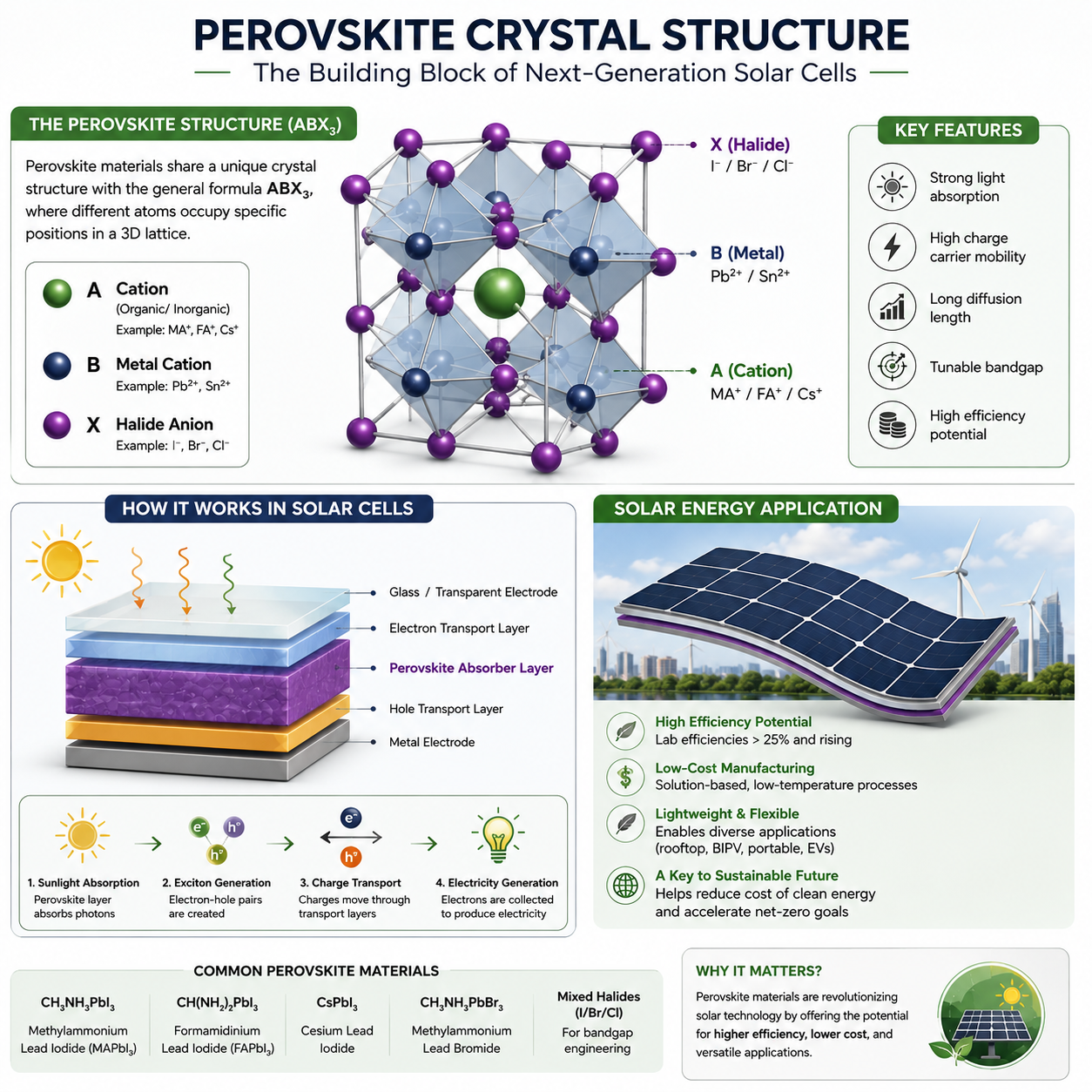
The perovskite structure follows a general chemical formula:
ABX₃ Where:
- A = Organic or inorganic cation
- B = Metal cation (commonly lead or tin)
- X = Halide anion (iodine, bromine, or chlorine)
The unique arrangement of atoms enables excellent charge transport and superior sunlight absorption.
Why Is Perovskite Structure Important?
The crystal structure provides:
- Strong light absorption
- High carrier mobility
- Long diffusion lengths
- Tunable band gaps
- High power conversion efficiency
These characteristics allow perovskite materials to convert sunlight into electricity more efficiently than many traditional semiconductor materials.
What Are Perovskite Solar Cells?
Perovskite solar cells (PSCs) are photovoltaic devices that use perovskite materials as the light-harvesting active layer.
Unlike conventional silicon cells that require energy-intensive manufacturing processes, perovskite cells can be produced using simpler and potentially lower-cost methods.
Basic Working Process
- Sunlight strikes the perovskite layer.
- Photons excite electrons.
- Electron-hole pairs are generated.
- Charges move through transport layers.
- Electricity is collected and delivered to the external circuit.
The result is efficient solar energy generation with reduced material requirements.
Why Are Perovskite Solar Cells Gaining Attention?
The rapid rise of perovskite technology is unprecedented in solar history.
Efficiency Growth
| YearApproximate Efficiency | |
| 2009 | 3.8% |
| 2012 | 10% |
| 2015 | 20% |
| 2020 | 25%+ |
| 2025 | 26%+ (single-junction laboratory cells) |
Few solar technologies have improved this quickly.
Researchers are now developing tandem solar cells that combine silicon and perovskite layers, achieving efficiencies above 30% under laboratory conditions.
Advantages of Perovskite Solar Cells
1. Higher Efficiency Potential
Perovskite materials absorb sunlight extremely effectively.
Benefits include:
- Higher power output
- Better low-light performance
- Improved energy yield
2. Lower Manufacturing Cost
Traditional silicon manufacturing requires:
- High-temperature furnaces
- Complex wafer processing
- Energy-intensive production
Perovskite cells can potentially be produced using:
- Printing techniques
- Roll-to-roll manufacturing
- Solution-based processing
This could significantly reduce production costs.
3. Lightweight Design
Perovskite solar panels can be:
- Thin
- Flexible
- Lightweight
This opens opportunities for:
- Building-integrated photovoltaics (BIPV)
- Portable solar products
- Electric vehicles
- Wearable electronics
4. Better Low-Light Performance
Perovskite materials perform well under:
- Cloudy weather
- Indoor lighting
- Diffused sunlight
This makes them attractive for diverse environmental conditions.
Perovskite Solar Panel Applications
Although still emerging commercially, perovskite solar panels could be used in:
Residential Rooftop Systems
Future rooftop installations may achieve:
- Higher efficiency
- Smaller roof footprint
- Greater annual generation
Commercial Buildings
Commercial facilities may benefit from:
- Lightweight installations
- Building-integrated solar facades
- Enhanced energy generation
Industrial Applications
Factories and warehouses could deploy:
- Large-area solar roofs
- Flexible solar coverings
- High-output photovoltaic systems
Electric Vehicles
Automotive manufacturers are exploring perovskite coatings that can generate electricity directly from vehicle surfaces.
Perovskite Solar Cell Price: What Can We Expect?
One of the most searched questions is:
What Is the Perovskite Solar Cell Price?
Currently, commercial-scale pricing remains limited because large-scale production is still developing.
However, experts expect perovskite modules to eventually cost less than traditional silicon modules because:
- Less material is required
- Manufacturing temperatures are lower
- Production processes are simpler
Estimated Industry Outlook
| TechnologyCurrent Commercial Status | |
| Silicon Solar Panels | Fully Commercial |
| Perovskite Solar Panels | Early Commercialization |
| Perovskite-Silicon Tandem Panels | Pilot Production Stage |
As production scales globally, perovskite solar cell prices are expected to decline significantly.
Challenges Facing Perovskite Solar Technology
Despite tremendous potential, several challenges remain.
Stability Issues
Perovskite materials can degrade when exposed to:
- Moisture
- Heat
- Oxygen
- UV radiation
Researchers are actively improving durability.
Lead Content Concerns
Many high-efficiency perovskite formulations contain lead.
Industry efforts focus on:
- Reducing lead usage
- Developing lead-free alternatives
- Enhancing recycling methods
Commercial Scalability
Laboratory success does not automatically translate to mass production.
Manufacturers must address:
- Long-term reliability
- Large-scale manufacturing consistency
- Bankability for solar projects
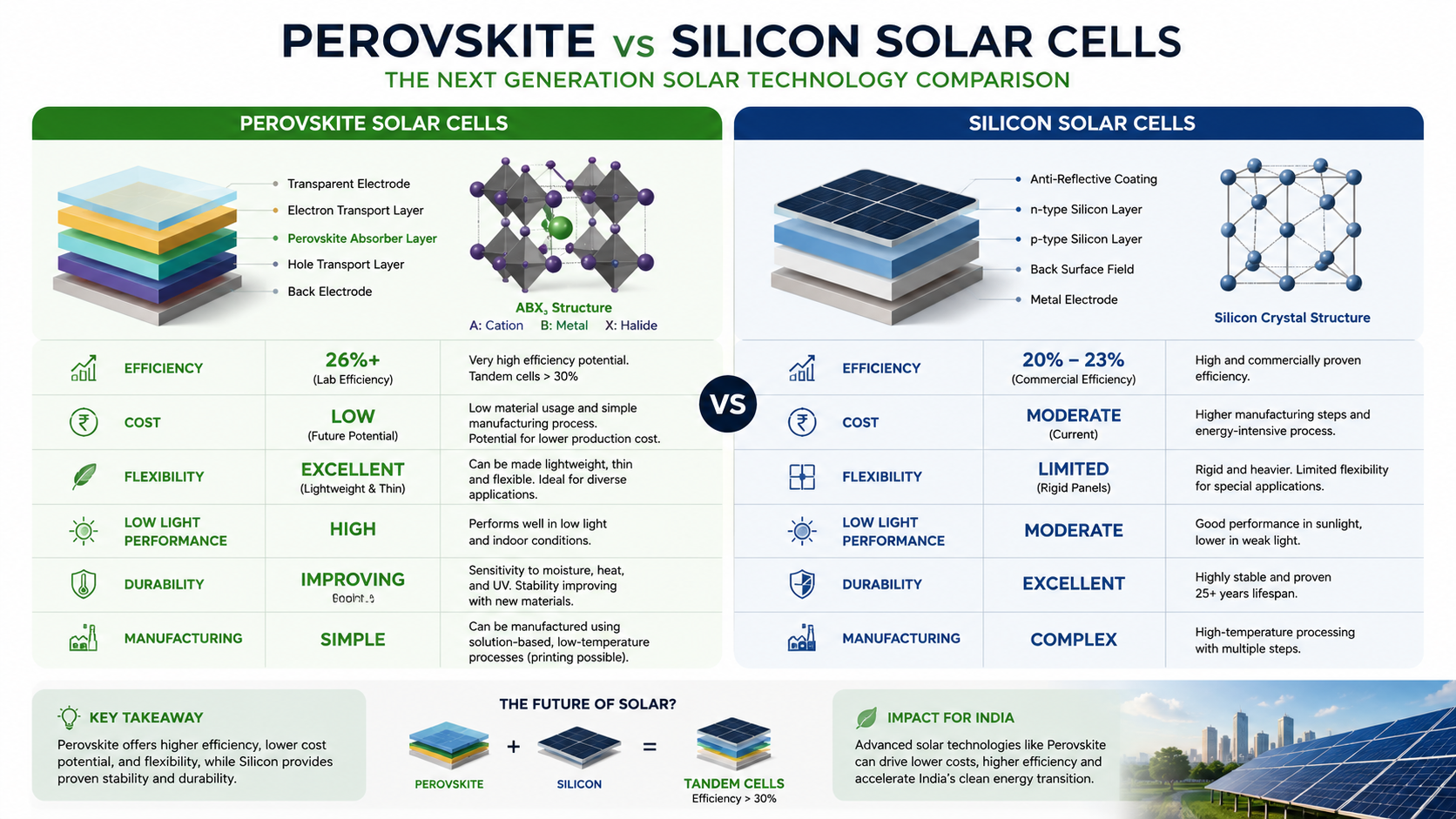
Perovskite vs Silicon Solar Cells
| Feature | Perovskite Cells | Silicon Cells |
| Manufacturing Cost | Potentially Lower | Established |
| Efficiency Potential | Very High | High |
| Flexibility | Excellent | Limited |
| Durability | Improving | Proven |
| Market Availability | Limited | Widely Available |
For now, silicon remains dominant, but perovskite technology may complement or eventually enhance traditional solar systems.
Future of Perovskite Solar Panels in India
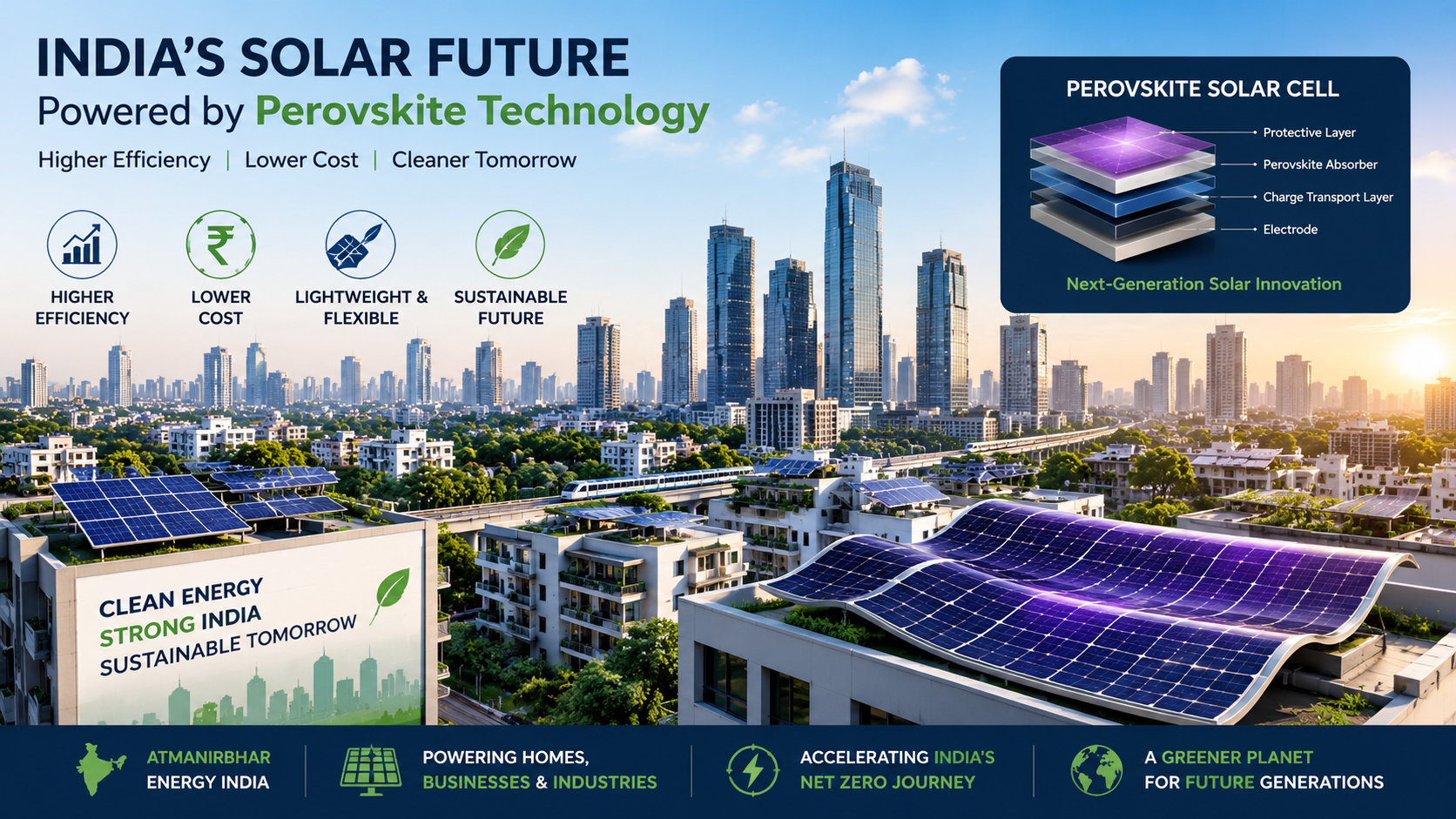
India is targeting ambitious renewable energy goals and rapidly expanding rooftop solar adoption.
Perovskite technology could help by:
- Increasing solar efficiency
- Reducing system costs
- Supporting urban rooftop installations
- Enhancing solar manufacturing capabilities
As India strengthens domestic solar manufacturing under various government initiatives, perovskite-based products may become an important part of the country's clean energy ecosystem.
Will Perovskite Replace Silicon?
Probably not immediately.
The most likely future is:
Tandem Solar Technology
Instead of replacing silicon, perovskite layers may be combined with silicon cells.
Benefits include:
- Higher efficiency
- Better energy yield
- Reduced land requirements
- Improved economics for large-scale projects
Many experts believe tandem solar cells will be the next major breakthrough in the solar industry.
Conclusion
 Perovskite solar cells represent one of the most exciting developments in renewable energy.
Thanks to their unique crystal structure, exceptional light absorption, and potential for low-cost manufacturing, perovskite solar panels could redefine the future of solar power.
While challenges related to durability and large-scale commercialization remain, ongoing research is advancing rapidly. For India's growing solar market, perovskite technology could eventually deliver more efficient, affordable, and versatile solar solutions.
For homeowners, businesses, industries, and renewable energy investors, understanding perovskite today means staying ahead of tomorrow's solar revolution.
FAQs
What is perovskite in simple terms?
Perovskite is a special crystalline material used in advanced solar cells that can convert sunlight into electricity very efficiently.
What are perovskite solar cells?
Perovskite solar cells are photovoltaic devices that use perovskite materials as the light-absorbing layer instead of conventional silicon alone.
What is the perovskite structure?
The perovskite structure follows the chemical formula ABX₃, where different elements combine to create highly efficient light-absorbing materials.
Are perovskite solar panels available in India?
Commercial availability remains limited, but several global manufacturers are actively developing perovskite-based solar modules.
What is the perovskite solar cell price?
There is no widely established retail market yet. Prices are expected to decrease significantly as manufacturing scales globally.
Are perovskite solar cells better than silicon?
Perovskite cells offer higher theoretical efficiency and lower manufacturing costs, but silicon currently provides superior durability and commercial reliability.
Can perovskite replace traditional solar panels?
In the short term, perovskite is more likely to complement silicon through tandem solar cells rather than fully replace it.
Why is perovskite important for renewable energy?
Perovskite technology could make solar energy more efficient, affordable, and accessible worldwide.


